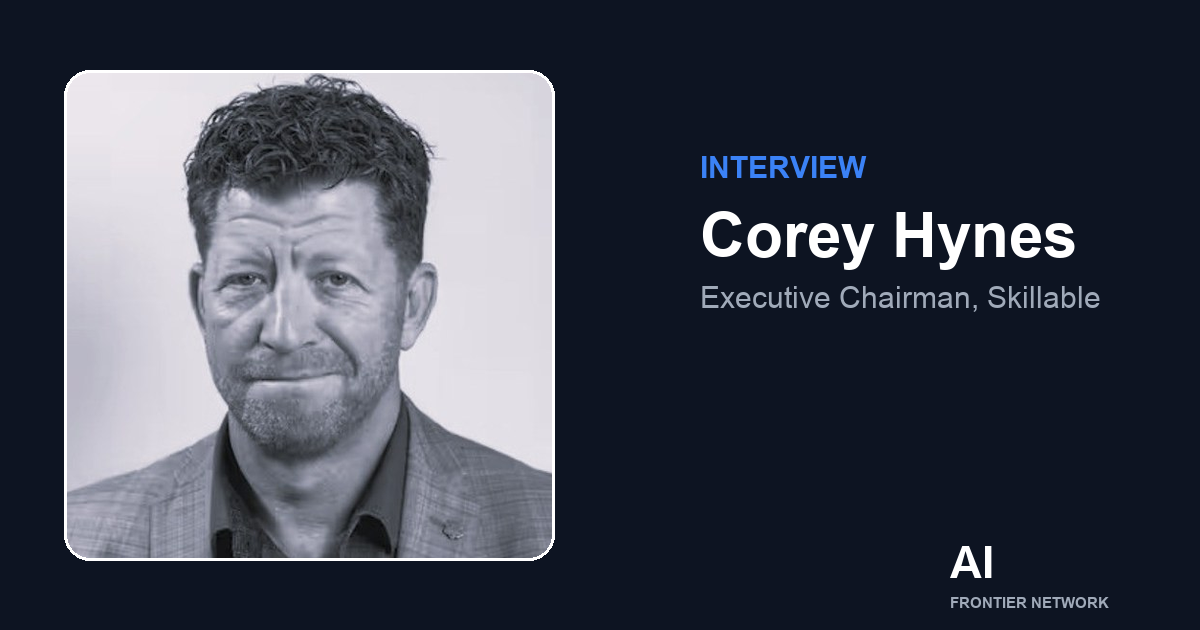
As part of The State of the AI Frontier 2026, AI Frontier Network invited leaders building and deploying AI in the real world to share where the frontier is actually moving. In this contribution, Corey Hynes, Executive Chairman at Skillable, gives a candid read on what changes in 2026 — and what to watch.
On the shift that defines 2026
The biggest shift is that AI moves from being a tool people use to becoming part of how work gets done. Today, many organizations are still focused on teaching employees how to use AI features. By the end of 2026, the more important question will be whether people can work effectively alongside AI to achieve better outcomes. That changes the skills required across the board. For builders, it means focusing less on creating models and more on creating systems people can trust and govern. For operators, success will increasingly depend on the ability to oversee, validate, and improve AI-driven workflows. And for end users, the most valuable skill will not be knowing how to generate an answer. It will be knowing whether that answer is any good. The emphasis shifts from execution to judgement.
On the real unlock
The capability I think many organizations are underestimating is AI's potential to accelerate skill development itself.
Most conversations focus on how AI can make employees more productive, but the bigger long-term opportunity may be how it transforms learning. AI can provide personalized coaching, generate realistic scenarios, deliver immediate feedback, and create opportunities for deliberate practice at a scale that has never been practical before.
The organizations that gain the greatest advantage will not necessarily be those with the most AI tools. They will be the ones that use AI to build workforce capability faster than their competitors. That's a much harder advantage to replicate.
On the trap to avoid
I think many leaders will continue to overestimate the value of AI adoption and underestimate the importance of capability building.
Deploying AI across an organization is relatively easy. Building a workforce that knows how to use it effectively is much harder. We're already seeing organizations invest heavily in licenses, copilots, and AI initiatives only to discover that usage doesn't automatically translate into business value. The mistake is treating AI as a technology challenge when it's really a skills challenge. If people aren't given opportunities to practice, experiment, fail, and develop judgement, AI becomes another tool that is available but underutilized. The gap between adoption and capability is where many AI strategies will struggle.
On the organization that adapts
AI is reinforcing something we've believed for a long time: the most durable skills are human skills. As routine work becomes increasingly automated, we're placing even greater value on critical thinking, adaptability, creativity, collaboration, and decision-making. From a hiring perspective, we're becoming less interested in what someone knows today and more interested in how quickly they can learn tomorrow. The pace of change is simply too fast to optimize for static expertise. We want people who are comfortable experimenting, questioning assumptions, and continuously evolving how they work. More broadly, we expect AI to take on more of the repetitive and predictable work, while humans increasingly focus on judgement, problem-solving, customer understanding, and the kinds of decisions that require context and accountability. The future is not humans versus AI. It's humans orchestrating AI to achieve better outcomes.
On the benchmark that matters
The metric I'd watch is not AI adoption. It's validated proficiency. By the end of 2026, I think leading organizations will increasingly recognize that measuring logins, prompt counts, or course completions tells you very little about whether people can actually perform effectively with AI. The more meaningful measure is whether employees can demonstrate capability in real-world scenarios.
The signal I'll be watching is how quickly organizations move from measuring exposure to measuring performance. The companies that can reliably validate workforce readiness, not just training completion, will have a significant advantage in turning AI investments into business results.