
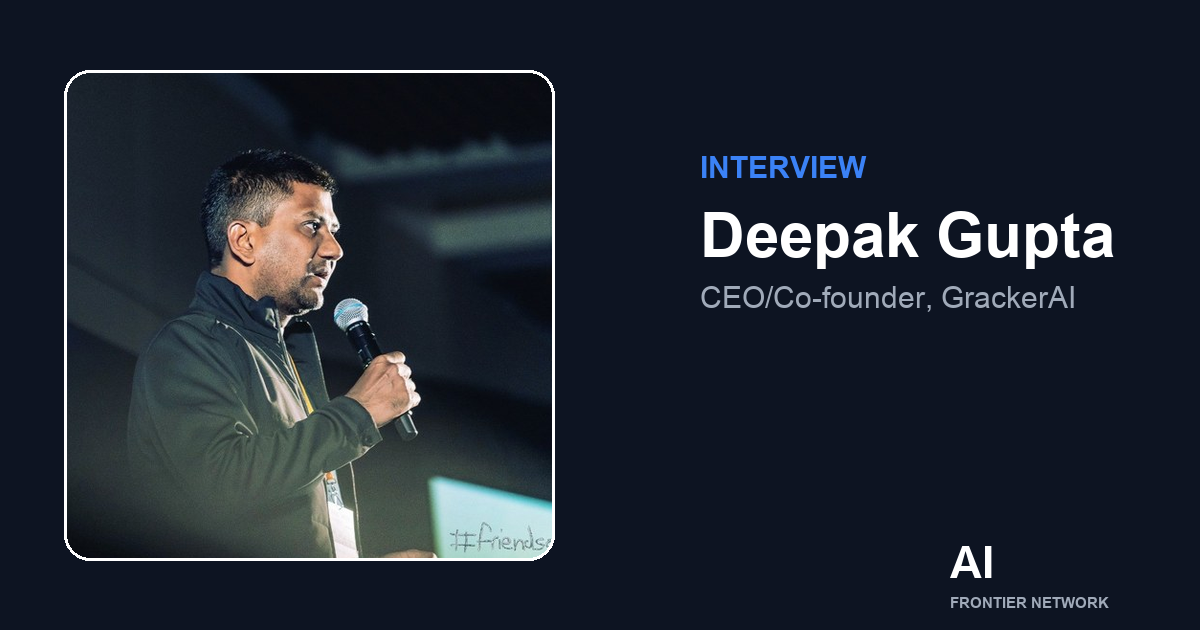
As part of The State of the AI Frontier 2026, AI Frontier Network invited leaders building and deploying AI in the real world to share where the frontier is actually moving. In this contribution, Deepak Gupta, CEO/Co-founder at GrackerAI, gives a candid read on what changes in 2026 — and what to watch.
On the capability that will reach the mainstream
Agentic AI moving from demos to production, specifically agents that can take real actions across systems rather than just generating text. The shift everyone's underestimating is the identity layer underneath it.
Once agents start authenticating into your tools, making purchases, and accessing data on your behalf, every organization will need to answer a question most haven't even asked yet: how do you give a non-human identity the right permissions without handing it the keys to everything? I spent a decade building identity infrastructure for humans. The next decade is about building it for machines, and that's going mainstream faster than most people expect.
On AI and decision-making
The bottleneck shifts from gathering information to verifying it. AI already compresses research that took analysts weeks into minutes. By 2027, the competitive edge won't be access to insight, since everyone will have that. It'll be the judgment to know which AI-generated conclusions to trust and which to challenge.
The organizations that win will be the ones that build verification into their decision loops, not the ones that automate decisions blindly. I see this in my own work: AI can draft the analysis, but someone with real domain experience still has to catch where it's confidently wrong.
On the most underestimated risk
Machine identity sprawl. Everyone's focused on prompt injection and model safety, which matter, but the quieter risk is that companies are deploying AI agents with static API keys and over-provisioned access scattered across their infrastructure.
Each agent is a new identity with credentials, and most organizations have no governance framework for them. We spent twenty years learning to manage human identities carefully. Now we're handing far more powerful access to autonomous agents with almost none of that discipline. When a breach happens through a compromised AI agent, it won't be the model's fault. It'll be the access control nobody set up.
On the advice that matters now
Start with a narrow, painful, measurable problem, not a broad transformation mandate. The companies that fail try to "adopt AI" as a strategy. The ones that succeed pick one workflow where they can prove value in 90 days, measure it honestly, and expand from there. Also: build your data and access foundations first.
AI amplifies whatever you already have. If your data is messy and your permissions are a mess, AI makes those problems worse, faster. Boring infrastructure work is what separates the companies getting real ROI from the ones stuck in permanent pilot mode.
On the trend worth watching
How AI is rewriting the way people discover information, and what that means for who gets found. We've spent 25 years optimizing for Google's ten blue links. Now buyers ask ChatGPT and Perplexity directly and get one synthesized answer with a handful of citations. That's a fundamental inversion of how visibility works online, and it's still early enough that the rules are being written right now. I'm building in that space because it's rare to watch an entirely new discipline form in real time.
It reminds me of the early SEO days, except the stakes and the pace are far higher.