
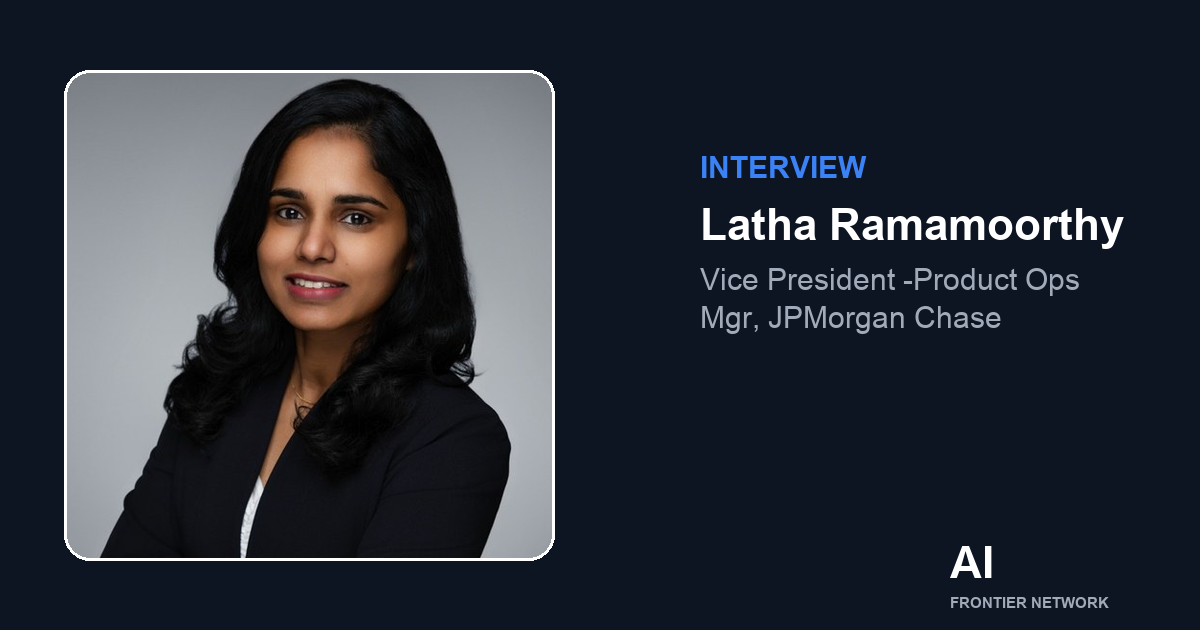
As part of The State of the AI Frontier 2026, AI Frontier Network invited leaders building and deploying AI in the real world to share where the frontier is actually moving. In this contribution, Latha Ramamoorthy, Vice President -Product Ops Mgr at JPMorgan Chase, gives a candid read on what changes in 2026 — and what to watch.
On the capability that will reach the mainstream
Agentic workflows with real tool access inside regulated environments. The model can already do the work—what becomes mainstream is the governance plumbing around it (identity, permissioning, audit) that finally makes enterprises comfortable letting agents act, not just suggest.
On AI and decision-making
Decisions get faster and more distributed, but the bottleneck shifts to accountability. Organizations that win will pair AI-accelerated decisions with a clear trust layer who approved it, on what evidence, with what ability to roll back. Speed without that scaffolding just means making bad calls faster.
On the most underestimated risk
The governance gap. Everyone's racing on model capability while the plumbing underneath permissioning, audit trails, rollback lags badly. The underestimated risk isn't a rogue model; it's deploying capable agents into environments with no accountability layer and discovering the gap only after something breaks.
On the advice that matters now
Don't start with the model start with the trust framework. Pick one workflow, build the governance and integration scaffolding properly, and prove value end to end before scaling. Most AI initiatives don't fail on intelligence; they stall on integration debt and the absence of a trust layer.
On the trend worth watching
The shift that lets small teams own large surface areas. AI is moving humans up the abstraction stack out of line-by-line production and into judgment, supervision, and the hard edge cases. As someone who builds developer platforms, watching individual builders operate with the leverage of a whole team is the part I find genuinely energizing.