Product management has always been a craft built on judgment, not just deciding what to build, but why it matters, when to pursue it, and what not to do. That judgment is developed over time through messy discovery, trade-offs, failed bets, and repeated exposure to uncertainty.
That process is beginning to shift.
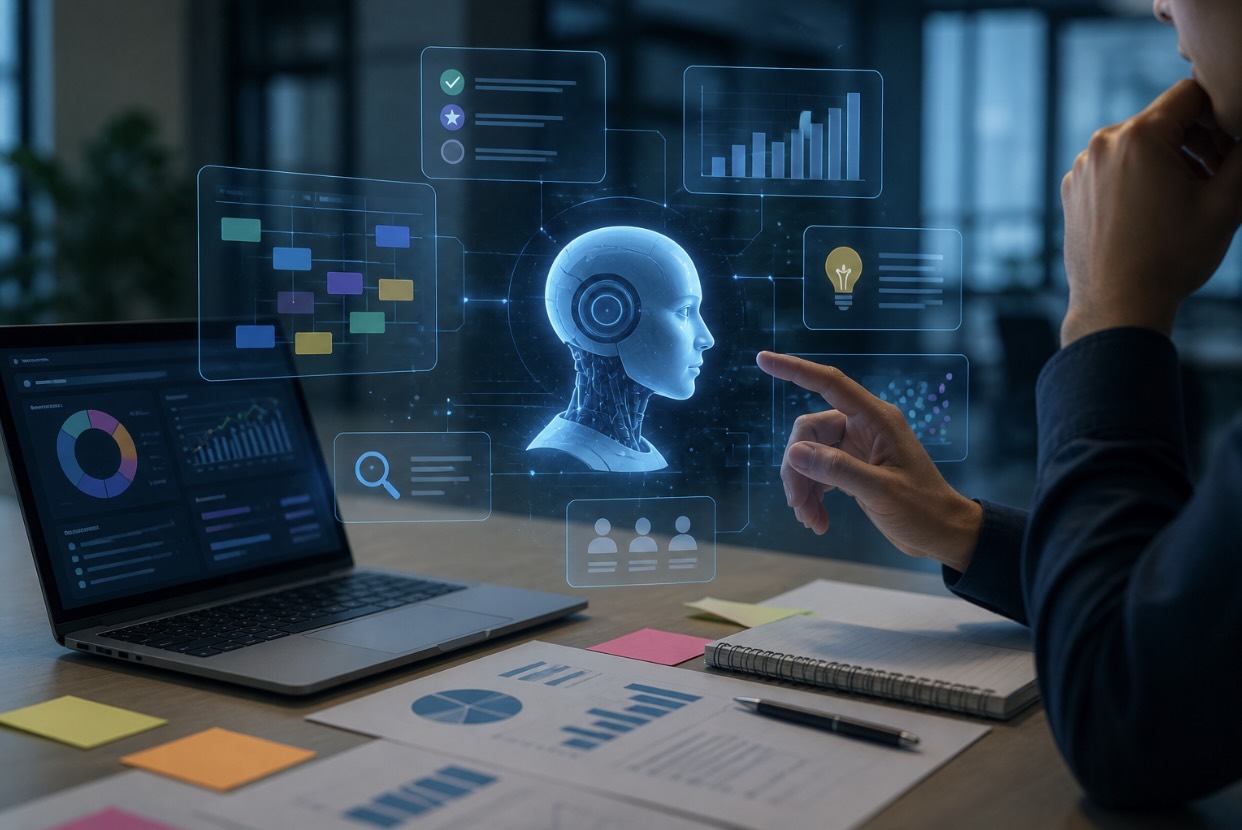
With the rise of agentic AI, product managers are no longer just using tools. They are working alongside systems that actively participate in decision-making. These agents can triage backlogs, propose priorities, design experiments, and even generate structured reasoning to justify their recommendations.
The promise is attractive: faster decisions, broader exploration of options, and less time spent on operational work. But underneath that promise sits a harder question:
If product managers increasingly delegate core decision-making tasks to AI agents, what happens to their judgment over time?
From Assistance to Delegation
There is an important difference between AI assisting decisions and AI effectively making them.
Earlier generations of tools helped PMs gather information: analytics dashboards, research summaries, documentation search. The PM still owned the thinking.
Agentic systems change the dynamic. They don’t just provide inputs; they generate outputs:
Ranked backlogs, with prioritization logic attached
Experiment designs, complete with hypotheses and metrics
Recommendations on what to build next and why
In many cases, the PM’s role shifts from originating decisions to reviewing and approving them. At first glance, this feels like leverage: less time on routine work, more time for strategy. But it also changes where and how often judgment is actually exercised.
The Subtle Risk of Judgment Atrophy
Judgment is not a static trait. It is a skill built through repetition. Backlog triage, for example, may appear operational, but it forces PMs to continually weigh:
Impact versus effort
Short-term wins versus long-term bets
Customer needs versus technical constraints
Similarly, designing experiments forces explicit thinking about causality, metrics, and risk. When these activities are delegated to agents, PMs risk losing the “reps” that sharpen their thinking. Over time, a subtle shift can occur:
Less active reasoning
Greater reliance on generated outputs
Lower confidence in independent decision-making
This is not a dramatic collapse; it is a slow drift. And it often remains invisible until a genuinely novel, high-stakes decision appears and the system’s patterns no longer apply.
The Other Side: Judgment Amplification
There is a compelling counter-argument: agentic AI can strengthen judgment when used well.
By taking on repetitive tasks, agents can free cognitive bandwidth for higher-order work. Instead of spending hours grooming backlogs, PMs can spend more time:
Defining strategic direction
Exploring new problem spaces
Engaging deeply with customers and stakeholders
Agents can also expand the option set. A human PM may think of three experiment ideas; an agent may generate ten, including non-obvious variants. That broader surface area can lead to better choices if the PM engages critically rather than passively.
In this view, AI does not replace judgment. It raises the ceiling by widening the search space and compressing the cost of exploration.
Where the Real Question Lies
The impact of agentic AI on PM judgment is not a binary “good vs bad” story.
The more useful question is: Does sustained reliance on agents change how PMs think and if so, in what direction?
Answering that requires looking beyond short-term productivity gains and examining how teams evolve over time.
A Longitudinal Lens on Teams
Imagine two types of product teams:
Agent-heavy teams that rely extensively on AI for backlog prioritization and experiment design.
Traditional teams that continue to run human-driven processes with lighter, assistive AI support.
In the early stages, the agent-heavy teams will almost certainly move faster. They will generate more ideas, run more experiments, and reduce operational overhead.
But over the longer term, more subtle differences are likely to emerge.
Decision Quality Over Time
The first dimension is decision quality:
Are teams making better decisions, or just faster ones?
Do AI-driven patterns transfer well to ambiguous or novel situations?
Agent-heavy teams may benefit from consistent, pattern-based recommendations. But they may also overfit to what the system has seen before. Traditional teams, while slower, may build stronger intuition through repeated, hands-on decision-making.
The divergence will likely appear in moments of uncertainty, when historical data is less reliable and first-principles reasoning matters more than pattern matching.
Overconfidence and Calibration
A second dimension is confidence.
Agent-generated recommendations often arrive with structured reasoning and a veneer of certainty. Over time, PMs may start to internalize that confidence even when their own understanding is shallow.
This creates the risk of a confidence–accuracy gap:
High confidence in decisions
Lower accuracy when conditions change
This is a subtle form of automation complacency: not that the system is always wrong, but that humans become less attuned to when it might be wrong.
Innovation vs. Optimization
Agentic systems excel at optimization - finding patterns, suggesting improvements, and refining funnels. Innovation, however, often requires breaking patterns, not just improving them.
If agents are trained primarily on historical data and existing product behaviors, they may naturally bias toward:
Smaller, safer experiments
Incremental improvements over bold shifts
Agent-heavy teams might run more experiments, but spend most of their energy tuning existing flows. Traditional teams, though less efficient, may be more likely to pursue unconventional ideas because they are closer to the raw ambiguity.
The trade-off becomes one of volume and safety versus originality and risk.
Signals to Watch in Practice
Even without formal studies, teams can watch for early indicators of how agents are affecting judgment:
Are PMs frequently challenging agent recommendations, or mostly accepting them as-is?
Are experiment portfolios becoming more varied, or clustering around similar themes?
Is confidence in decisions rising faster than realized outcomes?
Are roadmaps exploring new territories, or primarily optimizing existing ones?
These signals can help leaders understand whether AI is augmenting thinking or quietly replacing it.
Designing for Better Judgment, Not Just Speed
The impact of agentic AI is shaped by how workflows are designed.
Some practical ways to preserve and enhance judgment:
Require reasoning, not just approval: PMs should document why they agree or disagree with agent recommendations, not just click “accept.”
Encourage multiple options: Agents should present several plausible paths, not a single “best” answer, to keep comparative reasoning alive.
Expose uncertainty and assumptions: Showing confidence levels, data gaps, and key assumptions makes it easier to question the output appropriately.
Maintain periodic “manual” cycles: Running some prioritization and experimentation rounds without agents keeps decision-making muscles active.
Track predictions vs outcomes: Comparing expected impact (from humans and agents) to actual results helps calibrate both human and AI judgment over time.
These practices help ensure AI remains a partner in thinking, not a substitute for it.
The Shifting Role of the Product Manager
As agentic systems grow more capable, the PM role naturally evolves.
Less time generating options; more time evaluating them.
Less emphasis on mechanics; more emphasis on direction, framing, and judgment.
This shift is only healthy if PMs remain deeply engaged in the reasoning process. If they drift into passive approval, the role risks being hollowed out - highly leveraged on paper, but shallow in practice.
Final Thought
Agentic AI introduces a new kind of leverage into product management. It can accelerate workflows, broaden exploration, and reduce operational drag. But it also reshapes how judgment is developed and exercised. The long-term question is not whether PMs will use AI. It is whether they will use it to think better, or to think less. Because tools can generate options at scale. Judgment, the ability to choose wisely under uncertainty still has to be practiced, challenged, and owned.
And that remains the part of product management no system can fully replace.