For decades, product management’s biggest constraint wasn’t just building, it was deciding what to build, why, and when. Discovery, alignment, and prioritization have always been the core challenges.
That’s beginning to shift. Not simply because of better tools, but because the nature of product work itself is evolving. Generative AI is transforming how product managers think, explore, and communicate, not just how efficiently they execute.
It’s not about replacing product managers. It’s about amplifying them. Tasks that once required weeks now take hours, but the true disruption lies in how the flow of work feels.
Discovery Feels Different Now
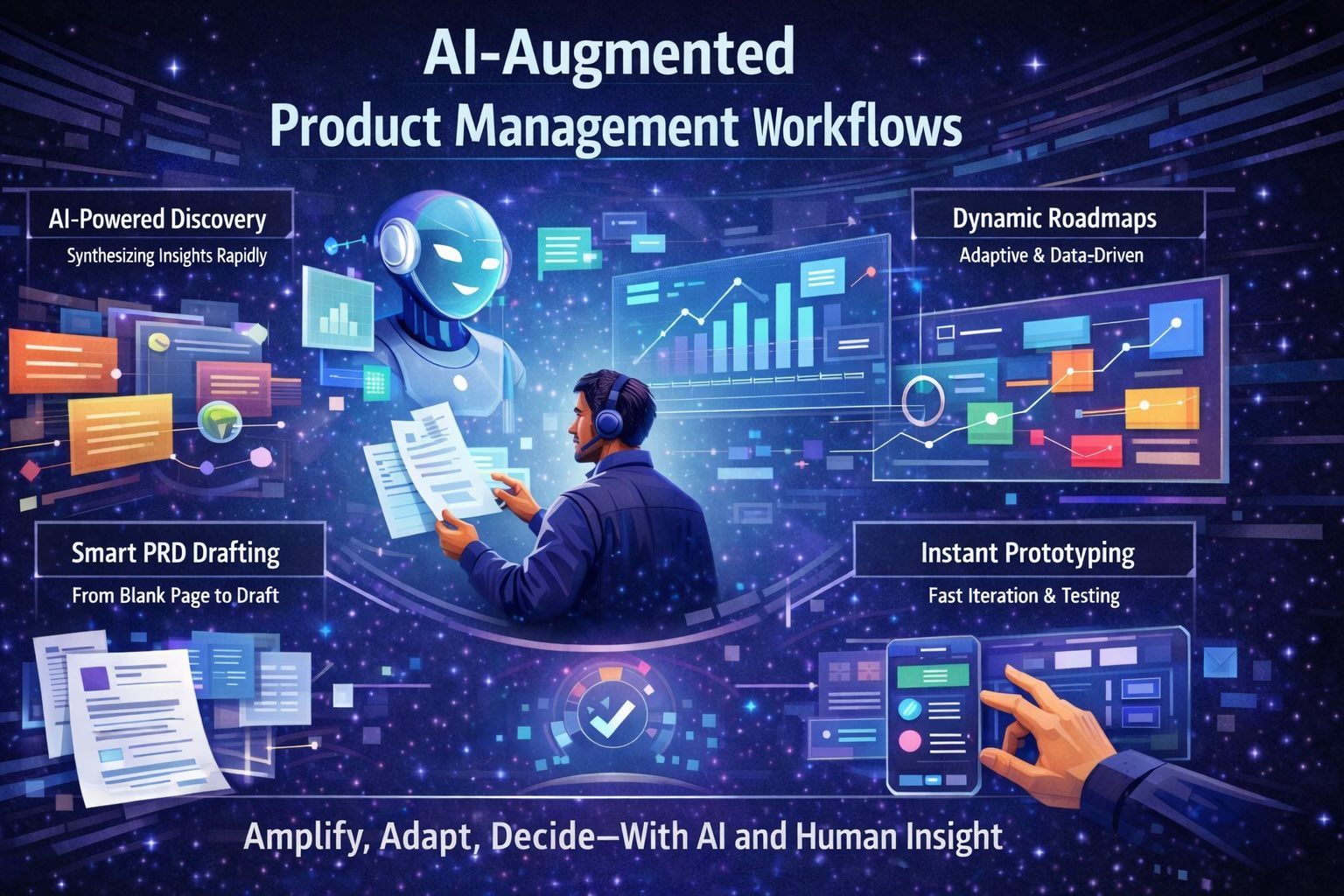
Discovery has always been a slow, deliberate process - collecting interviews, sifting through notes, and identifying patterns by hand. Today, AI can rapidly synthesize large volumes of unstructured data, from transcripts and customer tickets to research notes and surfacing themes within minutes.
It’s not flawless, but it’s remarkably useful. The result? Product managers now spend less time detecting signals and more time deciding which signals deserve attention. The focus shifts from “what are users saying?” to “what truly matters?”, and that changes the rhythm of discovery entirely.
PRDs Are No Longer Blank Pages
Writing a product requirements document used to start with a blank screen and a looming deadline. Now, it starts with structured thinking - problem, user, and goal fed into an AI assistant that generates a rich, imperfect draft.
That draft accelerates the process. It exposes fuzzy thinking and creates an immediate feedback loop: if the AI’s output feels unclear, the input likely was too. The PM’s role evolves from author to editor - shaping logic, refining narratives, and ensuring the story holds together.
Roadmaps Are Becoming More Fluid
Roadmaps once symbolized certainty. Today, they represent adaptability. With AI continuously analyzing customer feedback, behavioral data, and competitive signals, revisiting priorities becomes less disruptive and more habitual.
Instead of rigid lists of features, roadmaps are shifting toward evolving portfolios of bets focused on problems to solve and measurable outcomes. This transition isn’t just about smarter tools; it’s about greater comfort with change. Agile now means truly adaptive.
Communication Is Faster, But Needs More Care
AI-driven summaries, meeting notes, and updates save immense time. Communication that once consumed hours can be automated in minutes. Yet speed introduces new risk.
Output that sounds polished may not say much. Nuance can vanish beneath smooth formatting. That’s why review and reflection matter now more than ever: effective product communication isn’t just informational, it’s relational. It builds trust.
Prototyping Has Become Nearly Instant
Where once prototypes required cross-team coordination, AI-assisted design tools now make idea testing nearly frictionless. Simple mockups or flows can be built and iterated in hours, not days.
That immediacy changes behavior. There’s less hesitation and debate, instead more experimentation. Product teams can now think and learn through doing, bringing us closer to the ideal: fast, iterative exploration grounded in real feedback.
With Power Comes Risk
Generative AI outputs can appear authoritative even when they’re incomplete, biased, or wrong. That false confidence is dangerous.
When PMs stop questioning and start accepting, thinking gets outsourced. Explainability also remains a concern. AI can surface insights without showing the reasoning behind them, complicating alignment and decision-making.
The antidote is discipline: validate assumptions, trace the reasoning, and retain ownership of decisions. AI enhances velocity, but humans must maintain judgment.
The Role of the PM Is Evolving
As routine tasks accelerate, the PM’s value shifts upstream. Less time is spent gathering data or drafting artifacts, and more is spent interpreting, connecting, and deciding.
Clarity - the essence of the role remains, but its expression changes. Output matters less; critical thinking matters more. In many ways, the job is becoming harder, but also more strategic.
Where This Is Headed
Most teams today use AI to enhance existing workflows. Soon, they’ll redesign them entirely.
Discovery will become continuous.
Roadmaps will update dynamically.
Decisions will grow more data-informed, but still require human judgment.
The advantage won’t come from just using AI, it will come from using it thoughtfully. Knowing when to trust it, when to challenge it, and when to return to first principles.
Final Thought
AI doesn’t diminish product thinking, it illuminates it. If your reasoning is fuzzy, the output will show it. If your logic is clear, the results multiply faster.
AI amplifies capability, but it can’t replicate judgment, empathy, or context. Those remain human, and they remain the ultimate edge in building great products.