
Most AI systems don't fail at inference, they fail at integration. A model can hit 92% accuracy in testing and still cause operational chaos once it's deployed. Not because it got the math wrong, but because nobody designed the system around it to handle uncertainty, context boundaries, or what happens downstream when it's wrong.
We've spent years obsessing over models. What we're starting to realize is that the harder engineering problem was never inside the model,it's everything around it.
As AI systems move from advisory tools to autonomous actors, the whole equation changes. The question stops being "How well does the model predict?" and becomes something much harder: what happens when that prediction triggers action? When AI systems start initiating workflows, escalating cases, approving transactions, or denying access, they're not analytical tools anymore, they're decision infrastructure. And decision infrastructure has to be governed differently than software.
From Data Movement to Decision Movement
Traditional data pipelines were built to move information, ingest, transform, store, analyze. Simple and well-understood. You optimized for throughput and reliability, and for a long time, that was enough.
Autonomous AI systems do something fundamentally different. They ingest signals, enrich them with contextual data, generate predictions, score risk, trigger workflows, escalate exceptions, and record outcomes. That's not data movement anymore. That's a decision movement.
And the moment your pipeline starts moving decisions instead of just information, governance can't be a document sitting in a shared drive somewhere. It has to be baked into the architecture itself.
The Real Failure Pattern
Consider a fraud detection system deployed at scale. The performance metrics look great — precision is holding, loss is declining, everyone's happy. Then a product update shifts user behavior. The model adapts, but not evenly. It starts flagging one customer segment at slightly higher rates. Not enough to dent the aggregate numbers, but enough to change real people's experience with the product. And no alarms go off. Why? Because the system was designed to watch for prediction error, not for behavioral drift across decision pathways. The model did exactly what it was supposed to do. The architecture around it didn't. This is the gap most AI conversations still aren't addressing.
The C.O.R.E. Architecture for Governed Autonomy
Governance cannot live in policy documents. It must be embedded structurally.
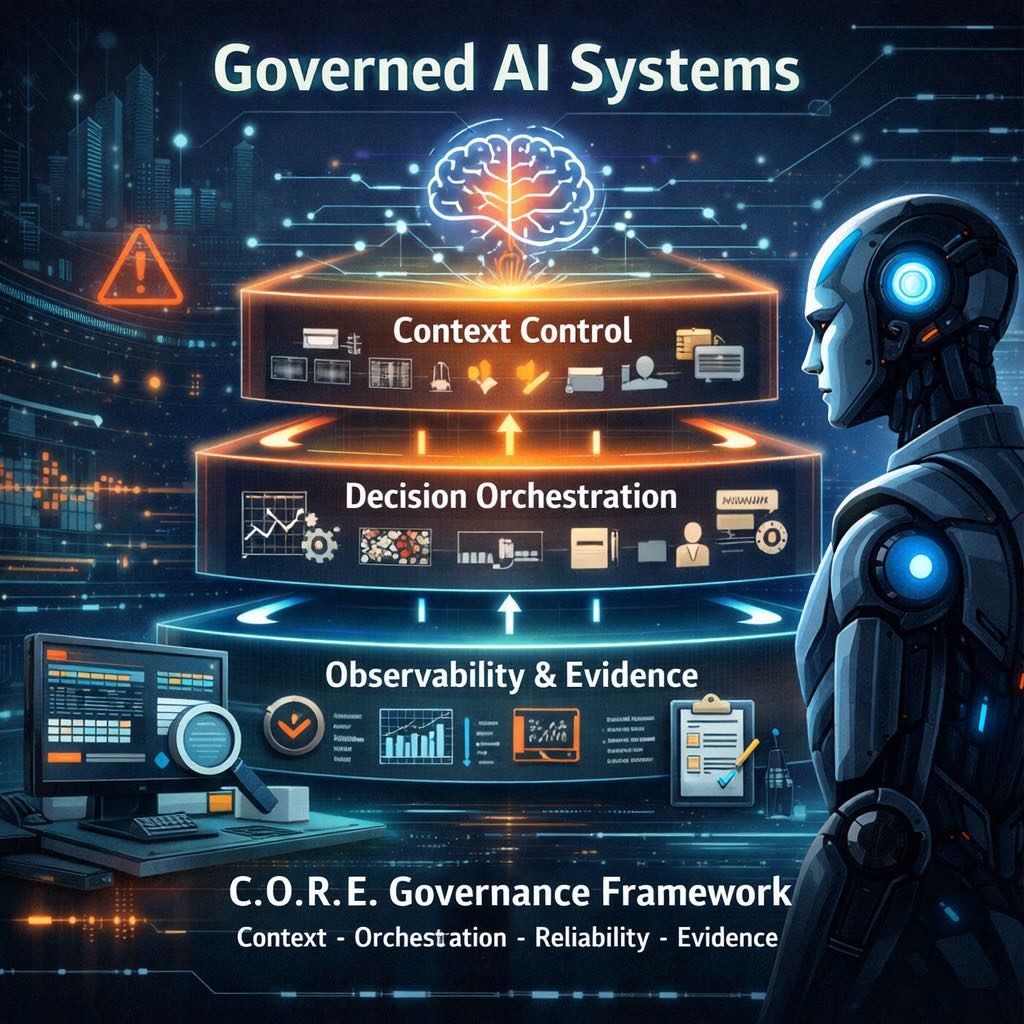
A governed autonomous system requires four architectural control planes. I describe this as the C.O.R.E. framework:
| Layer | Function |
|---|---|
| C – Context Control | Constrain what the system sees and uses |
| O – Orchestration of Decisions | Gate how predictions become actions |
| R – Reliability Through Monitoring | Detect behavioral change before it propagates |
| E – Evidence and Traceability | Preserve the full lineage of every decision |
Each layer addresses a different category of systemic risk.
C: Context Control
Models fail when context is unconstrained.
A large model exposed to unfiltered data is not intelligent,it is volatile.
Context control means designing strict boundaries around what the system can access and use:
Retrieval layers scoped by role, jurisdiction, and policy
Knowledge graphs that preserve relational constraints and domain logic
Data classification enforcement applied before inference, not after
Structured prompt contracts replacing open-ended inputs with bounded interaction patterns
Context is not enhancement. It is containment. Without containment, intelligence scales unpredictably.
O: Orchestration of Decisions
A prediction should never equal execution.
Between model output and real-world action, there must be a structured orchestration layer,one that evaluates:
Confidence thresholds
Risk exposure relative to domain tolerance
Active policy constraints
Escalation conditions and override protocols
Autonomy must be tiered deliberately:
| Tier | Mode | Governance Posture |
|---|---|---|
| 0 | Advisory only | Human decides; model informs |
| 1 | Human-in-the-loop | Model recommends; human approves |
| 2 | Bounded automation | Model acts within explicit constraints |
| 3 | Autonomous with audit | Model acts; post-action review enforced |
Organizations often slide between these tiers unintentionally. What begins as a recommendation quietly becomes automation through operational convenience and eroding oversight.
Orchestration prevents automation creep — the silent escalation of machine authority without corresponding governance escalation.
R: Reliability Through Monitoring
Once deployed, AI systems evolve — whether or not you intend them to.
Data distributions shift. Feedback loops compound. Edge cases accumulate. Upstream dependencies change without notice.
Monitoring model accuracy alone is insufficient. Systems must monitor:
Input and output drift — statistical and semantic
Decision pathway anomalies — shifts in which branches of logic are exercised
Escalation rate changes — sudden spikes or suspicious declines
Segment-level impact variation — differential effects across populations, geographies, or
product lines
Reliability is not static performance. It is controlled adaptation.If behavior changes, the architecture must detect it before it propagates — not after a regulator, a customer, or a journalist surfaces the consequence.
E: Evidence and Traceability
Every autonomous action must leave an explainable trail.
Not just a log entry — a decision lineage:
What context was retrieved, and what was excluded?
What confidence scores and thresholds were evaluated?
What policy rules were triggered or bypassed?
Why did escalation occur — or why did it not?
What was the state of the model and its inputs at the moment of decision?
If a system denies a loan, flags a transaction, or deprioritizes a candidate, the reasoning cannot be opaque.
Evidence transforms automation from authority into accountability. Without it, you do not have a governed system. You have a black box with elevated privileges.
Emergence Is Structural, Not Accidental
Modern AI systems interact across services. They respond to feedback. They influence downstream processes that, in turn, influence upstream inputs.
That interaction produces emergent behavior — not because of error, but because of complexity.
Emergence is inevitable.
Unbounded emergence is optional.
Without architectural controls, adaptive systems amplify blind spots — compounding biases, reinforcing failure modes, and creating correlations that no individual component was designed to produce.
With layered governance, adaptive systems amplify capability — learning within boundaries, adapting within tolerances, and surfacing anomalies before they become incidents.
The difference is design.
The Competitive Advantage Has Shifted
The industry's fixation on model scale is becoming a strategic distraction.
Model performance is converging. The frontier between leading foundation models narrows with each quarter.
Architectural maturity is not converging. It is diverging — rapidly.
The organizations that will lead in AI are not those with the largest parameter counts. They are those that:
Constrain context deliberately, treating information boundaries as first-class architectural decisions
Gate decisions structurally, with explicit tiering of autonomy and human oversight
Monitor behavior continuously, across segments and pathways — not just aggregate metrics
Preserve evidence systematically, building auditability into the decision flow rather than retrofitting it
The model predicts. The system decides.
And it is the system architecture — not the model architecture — that determines whether autonomy produces resilience or risk.
Closing
Moving beyond LLMs does not require abandoning innovation. It requires recognizing that intelligence without governance is acceleration without control.At scale, systems do not reflect capability.They reflect design.
And design becomes impact.