
Over the past few years, AI has stopped being an experiment. It has become part of everyday work in engineering, delivery, recruitment, and management. Many companies now use AI tools daily. But adoption does not equal impact.
According to the McKinsey report "The state of AI in 2025", 88% of organizations already use AI in at least one business function. Yet only about 6% have achieved enterprise-wide transformation that delivers real business impact. The gap between "we use AI" and "AI actually changes how we work" keeps growing.
From my perspective, the real challenge today is leadership. Technically, most organizations are ready. Culturally and managerially, many are not.
In this article, I’ll share how AI is changing the role of leaders, why traditional management approaches no longer work, and what leaders need to focus on to keep their teams effective.
How AI changes the way organizations work
To understand why leadership feels harder today, let’s take a look at how AI is actually embedded inside companies – not as a tool, but as part of the operating model.
One useful way to look at this is through a stages-of-maturity model presented by HR analyst Josh Bersin at HR Tech Europe in Amsterdam in 2025. What’s important here: this model does not measure the level of AI technology. It measures the maturity of organizational decisions.
Stage 1 – Tool users
At this stage, companies simply "add AI" – ChatGPT or other LLMs. AI helps individual specialists work faster, but the overall process stays the same. Productivity may improve locally, but the system does not change.
Stage 2 – Integrated worker
Here, AI performs part of the function, while a human controls the result.
For example, AI writes test cases or generates template code, and people review and finalize it. Efficiency increases, but responsibility and decision-making still sit fully with humans.
Stage 3 – AI-augmented teams
This is where a real shift begins. AI is no longer attached to individuals. It becomes part of team collaboration.
Teams operate as a symbiosis of people and multiple AI agents that:
- analyze risks,
- optimize roadmaps,
- suggest architectural options.
The unit of work changes from "a person with a tool" to a hybrid team.
Stage 4 – Superteams / AI-driven organizations
At this stage, AI is no longer a tool at all. It becomes a full participant in the work system.
The flow looks like this:
Human sets the intention → AI breaks it into tasks → the team executes → AI validates the outcome.
Researchers suggest that a significant majority of global companies are expected to transition toward this fourth stage within the next 3–5 years.
The difference between these stages is not about better models or more advanced tools.
It is about how work is designed, how responsibility is distributed, and how decisions are made. And as organizations move from tools to systems, leadership must evolve with them.
So, who is a leader in the age of AI?
When AI becomes part of how work is done, leadership can no longer rely on control, motivation, or personal expertise alone. Recent leadership research confirms this pressure. Studies show rising stress among managers, declining trust in leadership, and a growing sense that leaders simply don’t have enough time to lead anymore*.*
This is not a personal failure. It is a system problem. Most leadership models were designed for stable roles, predictable processes, and linear decision-making. AI breaks all three.
Another challenge is a growing perception gap between leaders and teams.
In their report "Superagency in the workplace: Empowering people to unlock AI’s full potential", McKinsey notes that leaders often underestimate how actively employees already use AI in their daily work, while overestimating "employee readiness" as a barrier to adoption.
How can this look in practice?
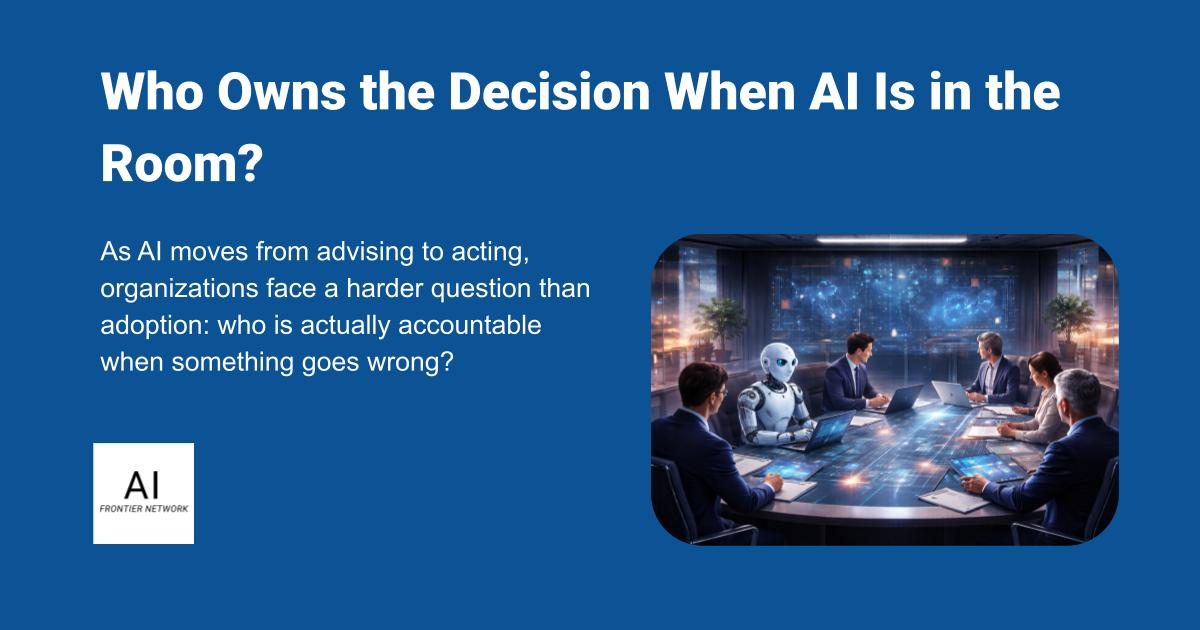
Imagine a mid-sized company with a sales operations team. The team uses AI to prepare forecasts, draft client proposals, and summarize call notes much faster than before. However, approval flows and decision ownership remain unchanged. To manage this new speed through old rules, many leaders instinctively add more oversight.
As a result, daily work accelerates, but decisions still get stuck in the system. People start asking: Who is responsible for the final numbers? Which decisions are human, and which are shaped by AI?
In this context, the question is no longer whether leaders should support AI adoption. The real question is how leadership itself must change.
From what I see in practice, effective leadership in the age of AI may be defined by three core shifts.
1. Normalizing uncertainty
AI accelerates change. Strong leaders do not pretend everything is under control. They help teams operate within uncertainty, without panic and paralysis.
2. Context instead of control
As AI reshapes roles and workflows, people need clarity of intent, not micromanagement. Boundaries are important – but boundaries are not control. Leaders must explain why things change, how AI affects the work, and what remains in human responsibility.
3. Being the point of truth
When things change faster than people can get used to, teams look for emotional stability as much as for direction. Leaders who create honest dialogue, avoid toxic emotional swings, and keep a steady pace – give teams something essential: trust.
In short, a leader in the age of AI is the one who holds the system together while it is being redesigned.
What leaders need to focus on next
Based on what we see in practice while integrating new leadership approaches, I would like to share several steps leaders should focus on right now:
1. Audit team capabilities
Before changing structures or processes, leaders need a clear picture of how work is actually done today.
This means understanding:
- which tasks are already supported by AI,
- where human judgment is still critical,
- how decisions are made in reality, not on paper.
Without this clarity, any further change is built on assumptions.
2. Redesign roles with AI in mind
As AI takes over parts of the work, roles naturally shift. If roles stay the same while work changes, responsibility becomes unclear.
Leaders need to revisit role definitions, decision ownership, and expectations – especially in areas where humans and AI now work together. This creates clarity for teams and reduces friction in daily work.
3. Build AI literacy across all functions
AI literacy is becoming a basic skill in the workplace. People need to understand:
- how to work with AI outputs,
- when to trust them,
- when to question them,
- and where responsibility remains human.
This applies equally to delivery, operations, HR, finance, and management.
4. Enable internal talent mobility
As roles evolve, some skills lose relevance while others grow in importance. Leaders, therefore, need mechanisms that allow people to move across teams and functions.
Internal talent mobility helps retain experience, reduce resistance to change, and adapt faster without constant external hiring. Specialists can move between roles or departments to build new skills without leaving the company.
Final thoughts
AI does not replace people. It replaces old roles, old processes, and old ways of thinking.
Leadership in the age of AI is about creating conditions where people can adapt, take responsibility, and work effectively alongside AI.
That is the work leaders are facing today – and it has already begun.