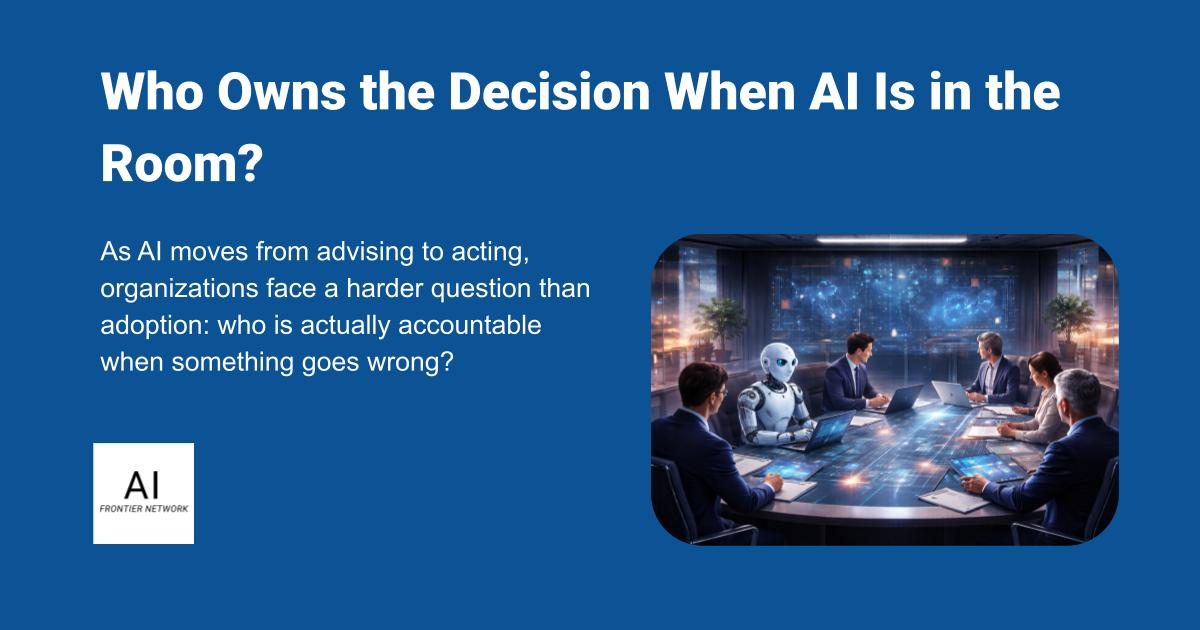
There is a quiet assumption spreading through AI-augmented organizations — that because a model made the call, no single person has to own it. That assumption is wrong, and it is becoming expensive.
The first distinction worth making is between recommending and deciding. When AI surfaces a ranked option or flags an anomaly, a human still holds the authority to act on it. But that authority can erode faster than anyone notices. A recommendation that gets accepted 95% of the time is, in practice, a decision — and if no named role is responsible for the 5% that gets pushed through uncritically, accountability has already slipped. The healthiest structures are explicit: the model produces an output, a named human role decides whether to accept it, and the boundary between the two is engineered into the workflow, not assumed.
When AI moves from recommending to acting — auto-approving, auto-routing, executing at machine speed — the stakes shift entirely. Delegated authority requires defined guardrails: what the system is permitted to do, where it must stop, and when a human must step in. Override and escalation paths are not optional features to add later; they are the mechanism through which ownership stays real. If a frontline team cannot quickly and safely say 'no' to an AI-driven action, then in any practical sense the AI is running the operation, regardless of what the org chart says.
Ownership gaps are where operational and legal risk quietly accumulate. They appear when a pilot gets handed off and every team assumes another has accountability — data assumes product, product assumes operations, operations assumes compliance. In that fog, models drift, workflows change, and no one feels empowered to stop it. The result is not just inefficiency; it is delayed escalation, blurred liability, and an organization that cannot prove responsible governance when it matters most.
Mature enterprises resolve this through deliberate role separation. Executives own the policy layer: what risk is acceptable, what level of autonomy is permitted, what outcomes are non-negotiable. Technical leaders own the mechanism: reliability, monitoring, explainability, and the ability to deploy, roll back, and document. Operations owns day-to-day use, overrides, and escalation. Compliance validates that the entire loop is defensible. When any of these groups assumes another is covering the uncomfortable parts, the gap becomes a liability.
Auditability is what separates an AI experiment from a real decision system. Every AI-influenced decision needs traceability — what the model recommended, who reviewed it, what inputs were live at the time, and what guardrails were in effect. Without that, the organization does not have ownership. It has plausible deniability, which is the most dangerous state of all.