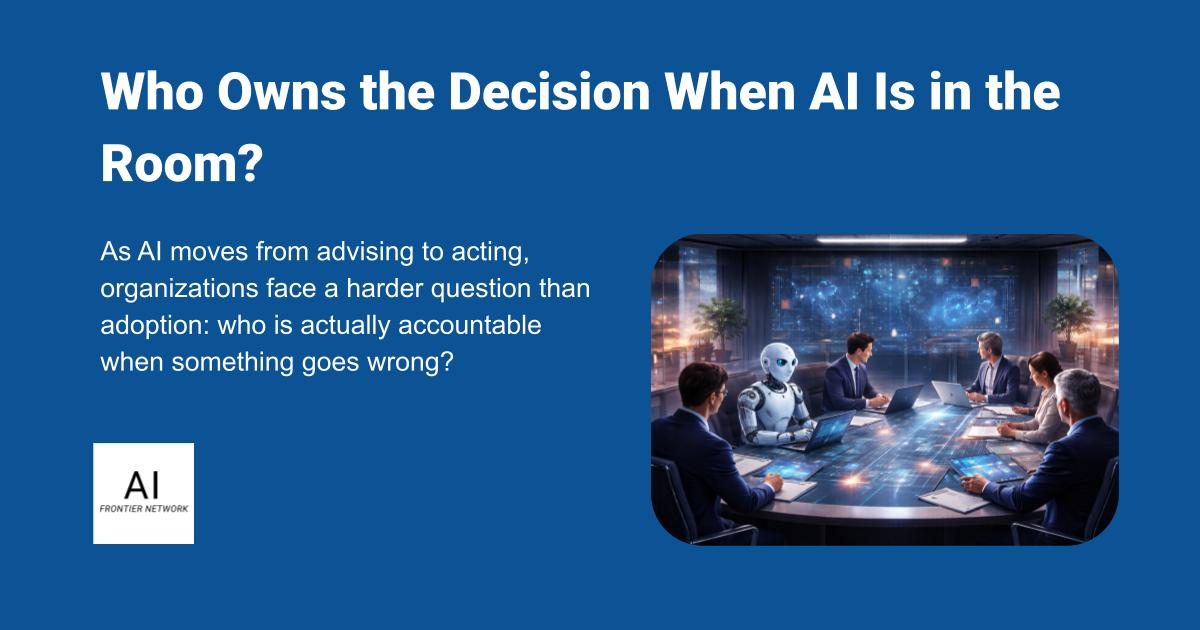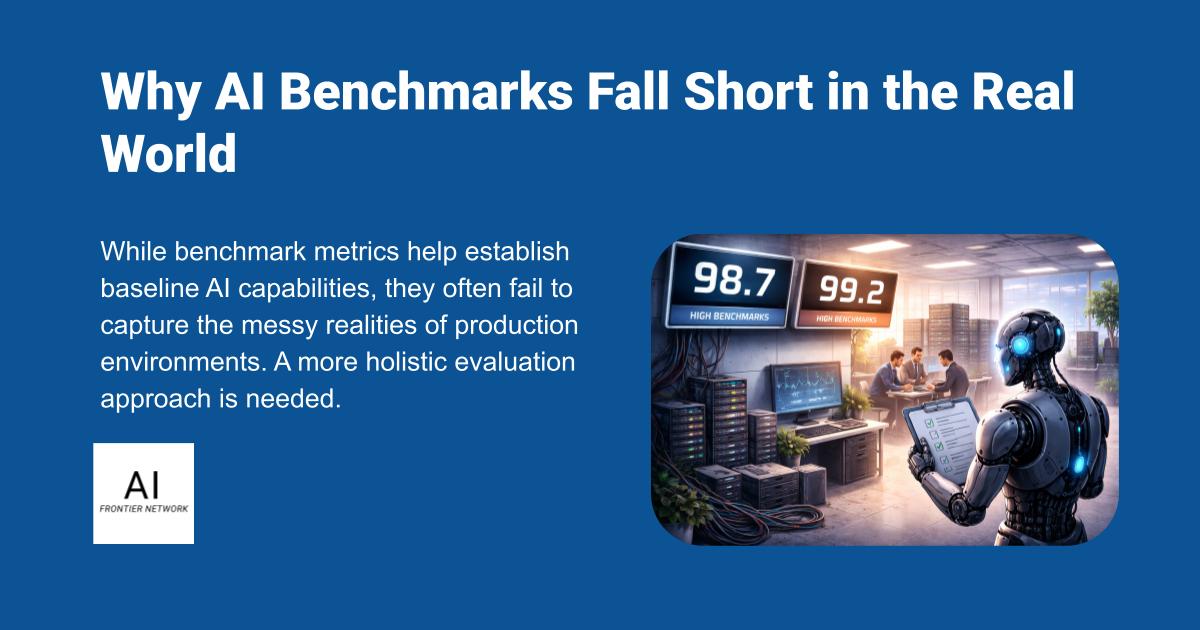
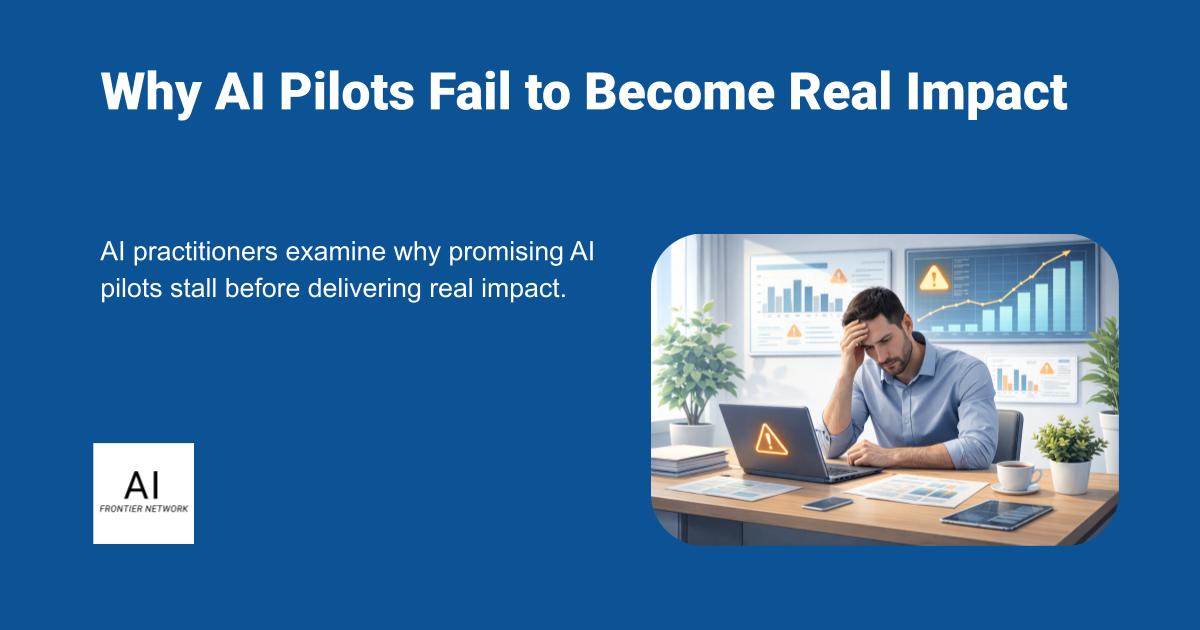
AI pilots rarely fail on model performance; they fail because organizations don’t convert a demo into an owned, governed, economically justified decision system embedded in real operations.
The pilot-to-production gap isn’t technical—it’s institutional
Most pilots are built to prove possibility. Real impact requires proving operability: who uses the output, when it changes a decision, what happens when it’s wrong, and how it will keep working as conditions drift. That’s why a team can celebrate a high-performing prototype while the business sees no measurable change in outcomes.
The contributors converge on a blunt diagnosis: pilots become “innovation theater” when they aren’t designed as decision systems from day one. Laxmi Vanam, Data Specialist at Vanguard, emphasizes that organizations stall when they treat AI as an experiment instead of operating infrastructure—optimizing novelty and model metrics while underinvesting in trust, governance, and workflow fit. The same pattern shows up in how demos are scoped: cherry-picked data, patient stakeholders, and minimal operational constraints that disappear the moment the work touches production.
That mismatch is not a minor gap; it’s a category error. Vivek Pandit, Principal Engineer at Cadence, notes that pilots are typically built on “happy path” conditions, while deployment demands resilience to messy data, shifting workflows, and a long tail of edge cases—plus the discipline of observability, evaluation, and security as first-class deliverables.
Decision rights beat model accuracy: ownership, liability, and escalation must be explicit
A pilot dies quietly when no one is willing to be accountable for the decision it recommends. In practice, “accountability” is not a philosophical debate; it’s a set of operational answers: Who acts on the output? Who is liable if it fails? What is the escalation path? What error is acceptable—and in which scenarios?
Ram Kumar Nimmakayala, AI & Data Strategist at WGU, argues that pilots often stumble after the showcase because “they have been handed off with no clear owner,” and because success metrics that impress builders don’t map to business accountability. When ownership is absent, the organization defaults to delay: one more test, one more review, one more stakeholder—until interest and budget evaporate.
The most important pre-production artifact isn’t a notebook; it’s a decision contract. Anshul Garg, Head of Product at Amazon, stresses that successful teams answer the accountability questions before deployment: what counts as “good enough,” who gets called when the model makes a mistake, and how risk is owned rather than endlessly deferred.
This is also where pilots collide with internal politics. Anuradha Rao, CEO at PANFISH Solutions Pvt Ltd, frames it as three uncomfortable questions AI forces into the open: who is accountable when the recommendation is wrong, which role loses authority, and which process must be rewritten. Without explicit decision rights, the pilot remains “safe”—admired, but not trusted with a real operational choice.
If you can’t translate metrics into P&L, you don’t have a business case
Many pilots survive on model performance and enthusiasm—right up until they meet finance. The pattern is predictable: the team reports improved AUC/F1, leadership asks “so what,” and the project can’t connect the result to revenue, cost, risk exposure, or throughput. When budgets tighten, the initiative is cut as an unexplained experiment.
Abhijit Ubale, Sr. Snowflake Data/ ML/ AI Engineer at Progressive, describes this as “a vacuum of economic language,” where technical teams optimize statistical measures that “carry no meaning for Finance, Operations or Legal.” The fix is not another dashboard; it’s a hard dollar hypothesis tied to a baseline, along with pre-agreed kill criteria.
Economics must include cost-to-serve, not just benefits. A pilot may look cheap because it was subsidized by an innovation budget, used a static dataset, and ran on ad hoc infrastructure. Production has a different cost curve: data pipelines, SLAs, monitoring, compliance artifacts, incident response, retraining, and cloud spend that scales with volume. If the ROI model doesn’t incorporate those realities early, “promising” becomes “unprofitable” right when the organization asks for scale.
The pattern that emerges is clear: Laxmi Vanam, argues that value measurement has to be coupled with accountability and workflow integration: if it’s unclear who acts on output and how value is measured, pilots remain isolated and never scale—regardless of model quality.
Adoption fails when incentives and workflows don’t change—especially for frontline teams
Even when the business case is sound, pilots often fail where the organization is least abstract: in the day-to-day workflow of people whose incentives were not designed for algorithmic recommendations. The model can be accurate and still be ignored if it adds friction, slows throughput, or threatens professional judgment without redesigning the process around it.
A common anti-pattern is deploying AI as an “overlay” rather than a redesign: a new alert, a new score, a new chat interface—while Monday morning meetings, approvals, and escalation rituals remain unchanged. Anuradha Rao, captures the difference in behavioral terms: if the operating cadence runs the same way, AI “hasn’t been implemented. It has been visited.”
The operational test is simple: does the system change a decision at a specific moment in a workflow, and is that moment engineered for adoption? Anshul Garg, notes that teams that ship treat deployment as organizational change, building reusable patterns and governance from the start instead of celebrating one-off wins that depend on custom workarounds.
Across contributors, a consistent signal appears: Ram kumar Nimmakayala, goes further: “Organizational structure kills more pilots than technical debt ever could.” The strongest models can’t overcome misaligned incentives, ambiguous authority, or a handoff that leaves no one accountable for outcomes.
Production readiness is a discipline: data contracts, reliability, and continuous evaluation
The “real world” breaks pilots through mundane forces: data quality decays, upstream schemas change, latency budgets get missed, behaviors drift, and users lose trust after inconsistent results. What looked stable in a sandbox becomes brittle under operational load.
The underlying dynamic is structural: Junaith Haja, Senior Data Engineer at Amazon, highlights the gap between visible internal progress and unchanged business outcomes: teams iterate on technical milestones while trust erodes as models change without explanation, data degrades, and user experience becomes inconsistent. At that point, leaders label the work experimental—not because AI can’t work, but because the system isn’t reliable enough to be depended on.
What becomes evident is that: Vivek Pandit, emphasizes that AI systems behave differently from traditional software: they are stochastic, require increased observability and telemetry, and need red teaming and evaluation as core deliverables—not add-ons. In other words, “MLOps” isn’t a tooling choice; it’s an operational posture where monitoring, rollback, and drift management are part of how the product is built and owned.
The evidence is consistent: Abhijit Ubale, underlines a related failure mode: pilots often rely on static snapshots that took days to sanitize, while production needs real-time operational feeds, data access approvals, and durable pipelines. Without data contracts and SLAs—freshness, coverage, and quality thresholds—the pilot’s output remains impressive but non-deployable.
Governance is not the brakes; it’s the mechanism that makes trust scalable
When organizations treat governance as a late-stage checklist, it shows up as friction: compliance reviews, audit questions, security gates, and stakeholder vetoes that weren’t planned for. But contributors consistently describe governance as the enabler of scale—because it turns AI from a clever artifact into a controlled decision system.
The highest-leverage governance move is to define where AI can act, where humans must approve, and how overrides work. Anuradha Rao, CEO at PANFISH Solutions Pvt Ltd, argues that winning teams “do not scale the model first—they scale trust,” starting with a narrow decision, explicit boundaries for autonomy, a human override, and auditable outputs.
That governance posture also reduces endless re-litigation. Anshul Garg, points out that without clear ownership and risk criteria, stakeholders keep requesting “one more test” because nobody wants to own the downside. By contrast, when governance artifacts are built into the delivery path—monitoring, auditing, escalation, documentation—the organization can move faster precisely because risk is legible.
Practitioners point to a recurrent theme: Abhijit Ubale, similarly warns that pilots die from “a thousand paper cuts” when every gatekeeper discovers unanswered questions at the end—data provenance, legal rights, model documentation, security posture, and cost ownership—because the pilot was never mapped to an authorized production pathway.
Conclusion: Demos scale possibility; decision systems scale outcomes
AI pilots fail to become real impact when organizations confuse model capability with operational readiness. The consistent message across contributors is that the pilot-to-production gap is primarily about accountability, workflow redesign, economic translation, and governance—not algorithms.
Treat the next “pilot” as a production-bound decision system: assign an owner with decision rights, write the P&L hypothesis and kill criteria, build data and reliability foundations early, and scale trust with auditable governance and human oversight. When those elements are in place, the AI stops being impressive—and starts being useful.