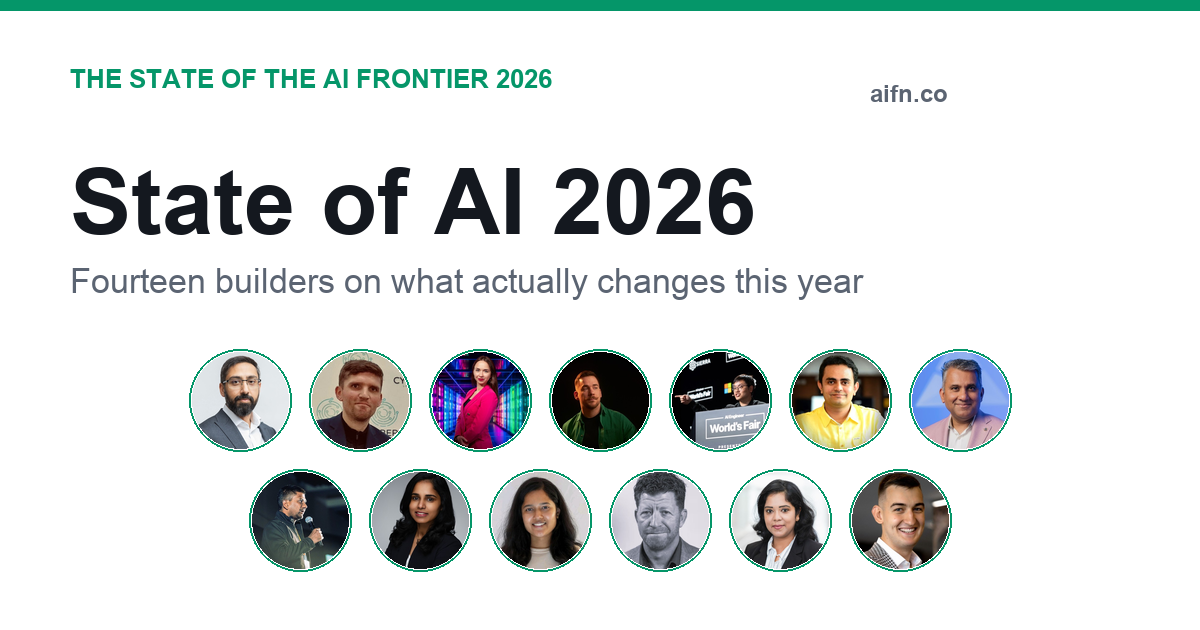
Over the past weeks, AI Frontier Network invited leaders who are actually building and deploying AI to answer a short, structured set of questions for The State of the AI Frontier 2026. Fourteen of them — founders, engineers, and operators at companies from Microsoft and JPMorgan Chase to fast-moving startups — gave us their candid read on where the frontier is really moving. Read together, their contributions are less a forecast than a field report from inside the work. A few themes surfaced again and again.
From experimentation to production: the reckoning
The loudest signal across the submissions is that 2026 is the year AI has to pay for itself. Agnese Jaunosane, co-founder and COO of Ajelix, frames it as a unit-economics reckoning: as consumption-based pricing bites, the question shifts from “are people using it” to “is it delivering value per dollar”. Karanjot Jaswal, CTO and co-founder of Cinchy, makes the same point from the cost side — unmetered AI spend quietly broke normal capital discipline, and the push for ROI is what forces the discipline back. Eugene Cheah of Featherless.ai adds an economics twist most miss: model variety, not raw frontier capability, is the maturity signal — the biggest model is a Swiss-Army knife, rarely the cheapest right tool. And in vertical software, Amol Nirgudkar, CEO of Patient Prism, is blunt about where the payback actually lands first: speed-to-lead and the missed call.
Governance and control: the real gate on agents
If capability is abundant, control is the bottleneck. Karanjot Jaswal argues the thing gating high-value adoption isn't the model — it's the ability to govern what an agent does and what data it touches. Latha Ramamoorthy, a VP at JPMorgan Chase, puts it memorably: speed without scaffolding just makes bad calls faster. Michael Charles Borrelli, a director at AI & Partners, reframes the constraint as an opportunity — machine-checkable guardrails can turn governance from a brake into an accelerant. And Deepak Gupta of GrackerAI points to the frontier hiding in plain sight: the sprawl of machine identities — the credentials of agents and copilots — as the next thing to govern.
Silent failures and the discipline of evaluation
Several contributors converge on a subtler risk than a model saying something wrong: a system that looks right and isn't. Dhivya Nagasubramanian, a lead AI architect at U.S. Bank, names it directly — silent failures that look like success — and argues teams should define what “correct” means before reaching for a model. Pratik Rupareliya of Intuz sees the same failure mode creeping in through cost optimization: silent quality degradation when requests are routed to cheaper models, which is why he treats evaluation as a standing discipline rather than a launch gate. Monisha Athi Kesavan Premalatha, a lead AI PM at Microsoft, watching agents compress cycle time in real supply-chain workflows, flags silent data drift as the thing that erodes trust quietly. And Pavlo Martinovych of Uptiq AI extends it to security: the new attack surface is convincing the agent, not breaching the perimeter.
The human question
For all the talk of autonomy, the contributors keep returning to people. Karanjot Jaswal cautions that treating human-in-the-loop as a cheap checkbox quietly kills the ROI it was meant to protect — if the reviewer has to redo the reasoning, you've duplicated the work. Corey Hynes, executive chairman of Skillable, argues the metric that matters is validated proficiency, not vanity adoption numbers — capability-building over deployment. And Paul Lee, COO of InnoCaption, makes the talent case plainly: the answer to AI is not to stop hiring juniors, and accessibility remains an underpriced way to expand who technology reaches.
What the builders are watching next
Asked what they're most excited about, the group points less at bigger models than at new ways of working. Andrii Yasynyshyn, CEO of Ralabs, is betting on spec-driven development — tools that turn intent into software — and insists the benchmark that matters is real P&L impact, not demo-day dazzle. Taken together with the governance, evaluation, and economics threads above, the 2026 picture is a maturing one: the frontier has moved from “what can it do” to “can we run it, afford it, and trust it.”
The contributors
Our thanks to the fourteen leaders who shared their perspective. Each contributed an individual feature to The State of the AI Frontier 2026 — explore their full answers:
Karanjot Jaswal, CTO & Co-founder at Cinchy — read the full contribution
Michael Charles Borrelli, Director at AI & Partners — read the full contribution
Agnese Jaunosane, Co-founder & COO at Ajelix — read the full contribution
Andrii Yasynyshyn, CEO & Co-Founder at Ralabs — read the full contribution
Paul Lee, COO at InnoCaption — read the full contribution
Eugene Cheah, CEO & Co-founder at Featherless.ai — read the full contribution
Pratik Rupareliya, Co-Founder and Head of Strategy at Intuz — read the full contribution
Amol Nirgudkar, CEO and co-founder at Patient Prism — read the full contribution
Deepak Gupta, CEO/Co-founder at GrackerAI — read the full contribution
Latha Ramamoorthy, Vice President -Product Ops Mgr at JPMorgan Chase — read the full contribution
Monisha Athi Kesavan Premalatha, Lead AI PM at Microsoft — read the full contribution
Corey Hynes, Executive Chairman at Skillable — read the full contribution
Dhivya Nagasubramanian, Lead AI Solutions Architect at U.S. Bank — read the full contribution
Pavlo Martinovych, Senior Product Manager at Uptiq AI — read the full contribution