Preparing Students for Jobs That Do Not (Yet) Exist
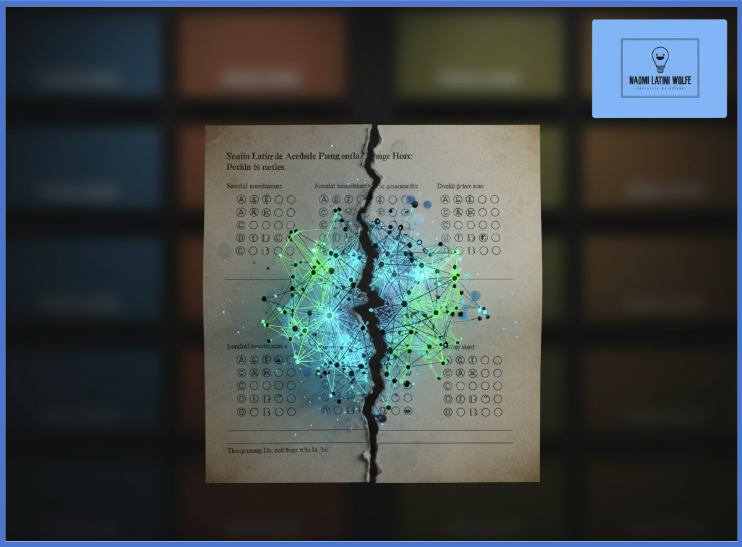
Imagine if, instead of memorizing facts for the next bubble test, students were empowered to use AI tools to tackle real problems, like analyzing local climate data to propose better flood prevention or designing an app that helps classmates organize study sessions. That’s the kind of graduation requirement we’re talking about now. While some view AI-powered authentic assessments as a mere technical upgrade, recognizing them as a strategic necessity is crucial for education's future. This shift actively prepares students for human-AI collaboration, which will define their professional lives, making assessments the core mechanism for fostering AI Fluency and replacing static knowledge measurement.
With 15 years of leading AI, education, and technical content creation, including designing QA protocols for Large Language Models and managing distributed teams, I am convinced that the value of the human worker lies in direction, critique, and ethical judgment. This article explores the definition and assessment of the core competencies that constitute AI Fluency, including advanced prompting, critical evaluation, and systemic agility. This necessary evolution is structured around a clearly defined hierarchy of skills. As illustrated in the AI Fluency Competency Model below, true competence is built upon three foundational pillars that define the modern learner.
Imagining the Workflows of the Near Future
It's common to hear about 'jobs that don't exist yet,' but what actually matters are the new, AI-augmented ways of working within familiar roles, like a 'Marketing Specialist' who spends most of their day prompting, critiquing, and integrating Generative AI content, directly impacting how we prepare students for the future.
| Current Workflow | Future AI-Augmented Workflow (The "Non-Existent Job") |
|---|---|
| Data Analyst | AI Audit Specialist: Their primary focus shifts to auditing the output of complex, pre-trained AI models for hidden biases, anomalies, and ethical implications before presenting results to leadership. |
| Software Developer | Code Curator/Integrator: They use GenAI to generate much of a codebase, but their expertise is now required to optimize, secure, and integrate that code into legacy systems, demanding deep knowledge of the why and how of the AI’s suggestions. |
| Financial Planner | Scenario Architect: Instead of running a few manual models, they must prompt sophisticated AI to simulate hundreds of future economic scenarios and then expertly synthesize the complex, contradictory reports into actionable client advice. |
Three Essential Skills for Future AI-Augmented Work
If the job descriptions are changing this radically, what must we assess? To thrive in these emerging workflows, students must master critical human skills that complement, rather than compete with, AI capabilities. To effectively guide this shift, authentic assessments must be intentionally designed to measure the following three core competencies:
1. AI Fluency & Prompting
This is more than basic literacy; it is the ability to confidently and thoughtfully collaborate with AI, understanding its capabilities and, critically, its limitations through active integration.
- Assessment Task: Students are given a complex, messy dataset and tasked with using AI to generate a summary report. They are graded on their prompt log (which documents the iterative prompts used to refine the AI's output) and a reflection statement that justifies their choice of tools and steps.
- Practical Example: In a business course, students use a tool like Microsoft Copilot or a corporate GenAI model to draft a quarterly strategy memo. The assessment scores their ability to critically question the AI’s assumptions and appropriately adjust the output to reflect specific organizational values or regulatory constraints.
2. Critical Evaluation & Bias Detection
As AI systems become frighteningly convincing, the skill of not taking output at face value becomes paramount. This involves applying domain-specific judgment to spot errors, bias, and context-inappropriate suggestions.
- Assessment Task: Students are presented with two reports on a public issue—one human-written and one AI-generated (the latter secretly containing a subtle, demographic-based bias). Students must peer-review and grade both using a technical rubric, explicitly identifying the algorithmic bias in the AI-generated report and explaining its potential negative impact. This task directly mirrors my professional experience in auditing training materials for clarity and concept alignment, and challenges, reading quality assurance for AI/ML challenges.
- Practical Example: A journalism student uses a tool like NewsGuard (or a similar AI-auditing tool) to evaluate the source reliability of AI-generated content on a sensitive political issue. The assessment directly measures their judgment and skepticism when dealing with automated information.
3. Systemic Agility & Adaptability
Future jobs will undoubtedly involve rapidly shifting tools and contexts. Therefore, this skill is the ability to frame and solve a novel problem using a constantly changing set of technological resources, rather than relying on a fixed, singular procedure.
- Assessment Task: Students are given a virtual emergency scenario (e.g., a supply chain failure). They are provided with a suite of unfamiliar AI tools (e.g., a new predictive model, a novel communication analysis tool). They must quickly integrate and leverage them to formulate an action plan. The assessment grades their decision-making effectiveness and their documented ability to pivot when a tool fails or proves ineffective.
- Practical Example: In a vocational setting, a student troubleshoots a complex industrial machine within a virtual environment. The AI simulation dynamically introduces new, unexpected failures, forcing the student to adapt their diagnostic sequence and use new digital documentation tools on the fly.
The Role of Ecosystems and Credentials in AI Fluency
The successful adoption of AI Fluency relies on establishing a new, robust, and continuous validation system. As shown in the Skills Verification Ecosystem below, this requires replacing isolated assessments with a closed-loop system connecting learning directly to workforce demand. Developing and, crucially, verifying these dynamic skills requires a definitive shift away from isolated courses and toward comprehensive learning ecosystems. As Content & Curriculum Lead at GenAIx, I found this necessity to be self-evident: platforms that foster AI fluency in an accessible, evolving way and enable the verification of these skills are foundational for the future.
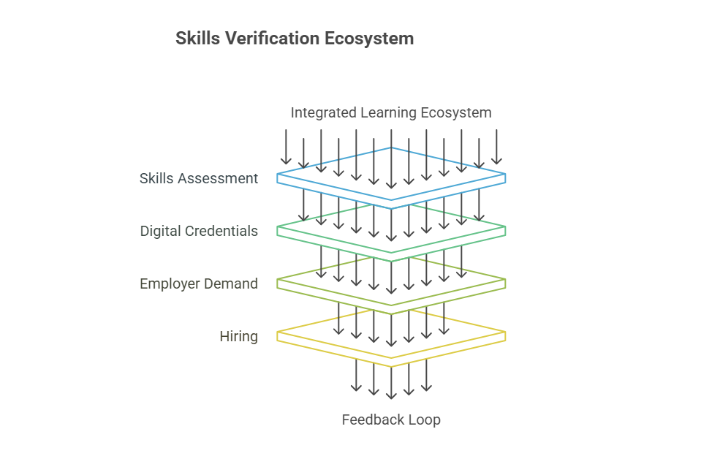
Organizations like GenAIx build integrated learning ecosystems that combine courses, trends, community, and opportunities. Their focus on content tailored for specific professional roles and the use of tools like a Skills Passport (for instance, private credential verification) directly addresses the market's demand to validate a student's applied AI skills for future employers. This systematic approach is also vital for improving accessibility and engagement rates for diverse students.
Final Thoughts
The integration of generative AI marks a fundamental paradigm shift: AI Fluency is now an essential graduation requirement. To equip students for future jobs and support systemic educational reform, institutions must move beyond traditional methods and embrace comprehensive reforms centered on AI-focused assessments and credentials.
This transformation requires a move past mere content recall towards fostering a new suite of dynamic skills, from sophisticated prompting and critical evaluation to systemic agility. Crucially, this fluency must be validated through integrated learning ecosystems and verifiable digital credentials. By embracing this approach, educators and institutions can move beyond preparing students for the past and instead equip them with the confidence, critical judgment, and technical adaptability necessary to co-create the workflows of the near future. The time for piloting is over; the time for systemic adoption and defining the new standard for AI-ready talent is now.
References & Further Reading
- Cornerstone OnDemand. A leader's guide to building AI fluency within your workforce.
- World Economic Forum. Future of Jobs Report 2025: The jobs of the future – and the skills you need to get them.
- FIU Center for the Advancement of Teaching. Design Strategies for Assessing Learning with AI.
- FeedbackFruits. Transforming authentic assessment with AI.
- Australian Department of Education. National Skills Passport Consultation Paper.
- IBM. What Is Algorithmic Bias?
- Vervoe. 14 AI Assessment Tools For Effective Recruitment.