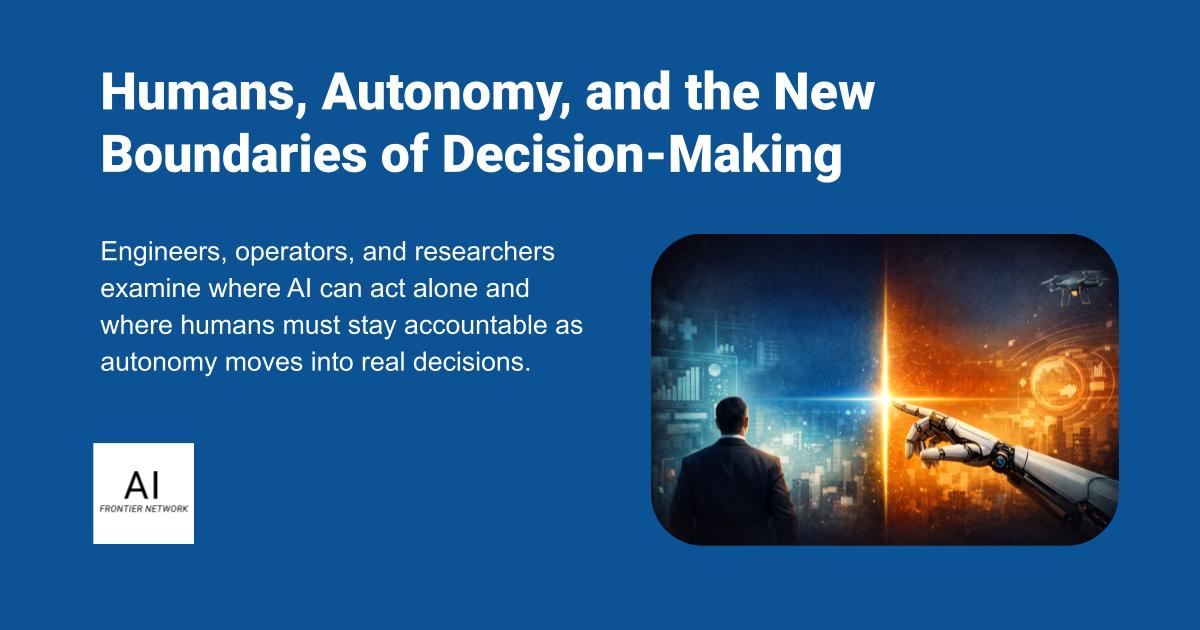
Humans, Autonomy, and the New Boundaries of Decision-Making
Executives on where AI should act alone and where humans must remain accountable
AI systems are no longer experimental tools sitting on the edge of production. They are routing customer requests, approving transactions, shaping medical workflows, and influencing decisions that affect millions of people daily. The question is no longer whether AI can act autonomously. The real question is who owns the consequences when it does.
Across industries, leaders are converging on a shared rule. Autonomy is not defined by capability. It is defined by accountability.
We asked engineers, strategists, healthcare leaders, and AI ethicists where the line should be drawn. Their answers outline an emerging operating doctrine for autonomy.
The reversibility test
A consistent boundary appears across nearly every domain. Autonomy is acceptable when mistakes are cheap, reversible, and contained. It becomes dangerous when failure carries lasting consequences.
Vivek Pandit, Principal Engineer at Cadence, frames the rule bluntly:
“An AI system can act autonomously when mistakes are cheap, reversible, and contained… Humans must stay in the loop when actions touch a source of truth or have irreversible consequences.”
That distinction reshapes the debate. The line is not drawn where machines fail. It is drawn where humans cannot afford failure.
Milind Jagre, Machine Learning Engineer at Apple, emphasizes that even high-performing systems must defer to humans when stakes escalate:
“AI can optimize for a metric, but it doesn’t understand long-term business context… AI should suggest the ‘how,’ but humans must define the ‘what’ and the ‘should.’”
Several contributors describe this as a risk budget. Laxmi Vanam, Data Specialist at Vanguard, summarizes the pattern succinctly:
“AI performs best when patterns are stable and outcomes are reversible… As impact and uncertainty increase, autonomy should taper and human oversight should increase.”
Accuracy alone does not erase responsibility. A warehouse sorting error is rework. A mispriced mortgage or a clinical misjudgment can shape decades of a person’s life. The reversibility test becomes the gatekeeper of autonomy.
Accountability cannot be automated
A second theme runs through every response. Institutions require a human name attached to consequential decisions.
Anshul Garg, Head of Product at Amazon, captures the tension:
“The question isn’t whether AI can make a decision, it’s whether anyone can explain what went wrong when it does.”
Autonomy without ownership creates what contributors repeatedly describe as an accountability vacuum. When an automated system denies a loan, flags a patient, or triggers an intervention, affected individuals deserve more than “the model said so.” Someone must be able to explain the decision in plain language and accept responsibility for the outcome.
In healthcare, that requirement becomes non-negotiable. Jordan Henry, Founder and Chief AI Ethicist at Veritas AI Consulting, argues:
“If a human could not realistically understand, question, or override an AI-driven action in the workflow, that action is too autonomous for high-stakes clinical use.”
The structure of accountability matters as much as the decision itself. Ram Kumar Nimmakayala, AI & Data Strategist at WGU, reduces it to a practical test:
“If you can’t easily explain to a regulator what the override mechanism is in under two minutes, your automation has gone beyond prudential tolerance.”
Oversight cannot be symbolic. A human in the loop who functions as a passive click-approver is not accountability. Real governance requires visible escalation paths, frictionless overrides, and workflows where disagreement with the system is normalized.
As Anshul Garg puts it:
“Autonomy without accountability isn’t innovation, it’s liability waiting to happen.”
What breaks when autonomy arrives too early
Premature autonomy introduces a quieter but more dangerous failure mode. Systems do not collapse because models are imperfect. They collapse because humans disengage.
Milind Jagre warns of what he calls the automation paradox:
“When a system is 99% autonomous, the human operator tunes out. When the 1% failure occurs, the human is too disengaged to intervene effectively.”
Multiple contributors describe the same pattern across industries. Automation bias encourages over-trust. Situational awareness fades. Skills erode.
Jordan Henry notes that in clinical settings, over-reliance can produce omission errors and deskilling:
“Clinicians can over-trust AI and adopt erroneous recommendations… reinforcing the need for explicit review points and culturally normalized AI second-guessing.”
The danger is not a single bad output. It is correlated failure combined with human complacency. Highly autonomous systems amplify mistakes at machine speed while the people responsible are tuned out of the loop.
Vivek Pandit describes the practical symptoms:
“The common failures are silent wrong actions, looping retry storms, and automation bias where humans stop checking because it usually works.”
Oversight must remain exercised, not ceremonial. Override paths must be muscle memory, not emergency procedures buried in documentation. When autonomy removes the opportunity for humans to maintain skill, the system becomes brittle.
The emerging design pattern: tiered autonomy
The consensus solution is not binary control. It is staged autonomy.
Instead of asking whether a system should be autonomous, leaders increasingly design graduated authority:
suggest only → draft with approval → limited execution → monitored autonomy → expanded autonomy
Promotion between stages requires evidence, telemetry, and incident-free performance.
Vivek Pandit outlines the architecture:
“Start with suggest only, then draft plus human approve, then limited scope execution… Every promotion needs gates with measured performance and strong observability.”
This model treats autonomy as a privilege a system earns. Each expansion of authority must be justified by reliability, explainability, and the organization’s ability to intervene. Crucially, rollback remains part of the design.
Naomi (Prof L) Latini Wolfe, Professor of Sociology and AI-Enabled Education at GenAIx, reframes the objective:
“The goal is not full automation, but reliable partnership between humans and machines.”
Autonomy is not about removing people. It is about pairing machine efficiency with human judgment.
A living boundary
The most important takeaway from the panel is that the line between human and machine is not static. It is negotiated continuously.
Economic pressures shift. Regulations evolve. Social expectations change. Systems improve, and so do the risks they introduce. The boundary must be revisited as a living agreement rather than treated as a finish line.
Naomi (Prof L) Latini Wolfe captures the institutional stakes:
“We don’t just lose efficiency when autonomy drifts too far. We lose the moral fabric of the relationship.”
Organizations that thrive in the autonomous era will not be those that automate the fastest. They will be those that treat accountability as infrastructure. They will design systems where reversibility is explicit, ownership is named, and human judgment remains embedded in the architecture.
Autonomy is not the absence of humans. It is the disciplined integration of machines into human responsibility.
The frontier is not human versus AI.
It is calibrated partnership.